What Hand-Raising Copper Actually Means
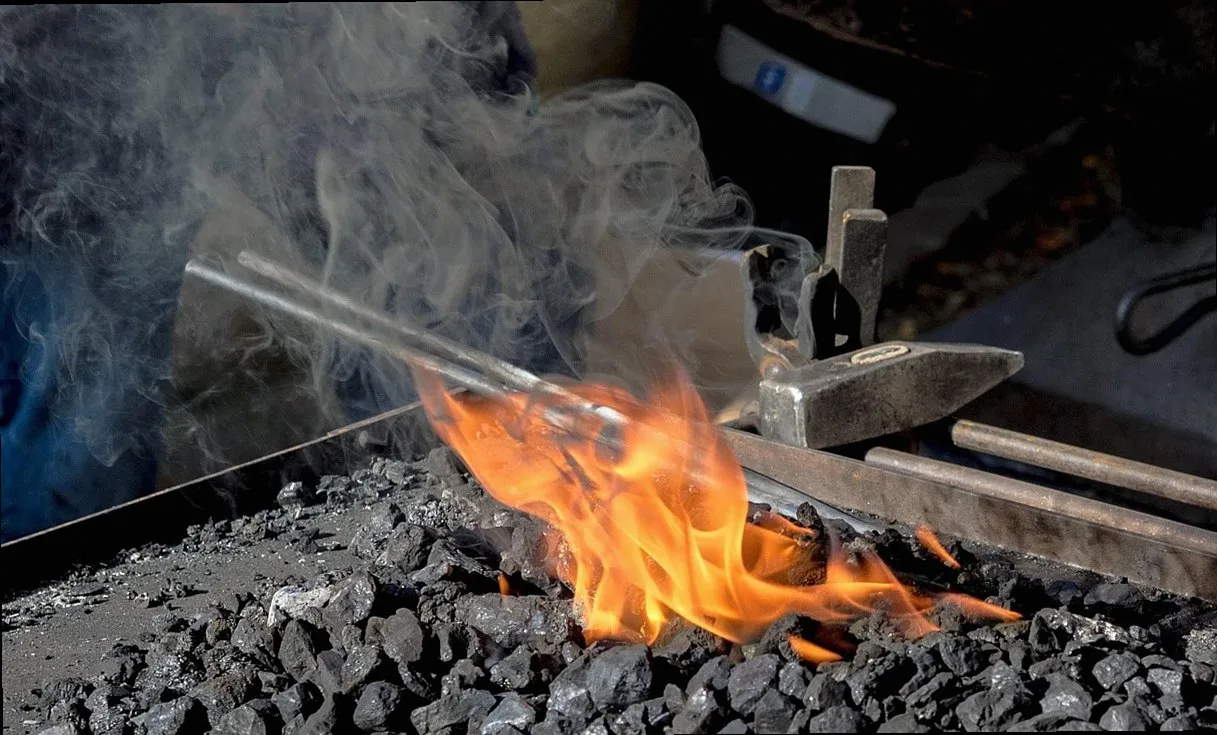
When I describe a sink or a bowl as hand-raised, I am not using it as a marketing term. It refers to a specific technique: shaping a flat sheet of metal into a three-dimensional form by working it over a stake or anvil with a hammer, gradually moving the metal rather than cutting and joining it. It is slower than fabrication, and the result looks and feels different.
The basic process
You start with a flat disc or rectangle of copper sheet. The first passes with the hammer are rough. You are moving a lot of metal quickly, and the piece looks terrible at this stage. The copper work-hardens as you hammer it, which means it becomes stiffer and more resistant to further shaping. Before it gets too hard to work, you anneal it: heat it with a torch until it glows a dull red, then quench it in water. This softens the metal and lets you continue.
This cycle. Hammer, anneal, hammer, anneal. Repeats many times over the course of making a piece. A medium-sized bowl might go through eight to twelve annealing cycles. A sink basin takes considerably more.
- Mark the blank
- Rough-raise the basic form
- Anneal when the metal stiffens
- Refine the shape with lighter passes
- Planish the surface smooth (or leave the texture)
- Final anneal and finishing
Why the texture matters
The hammer marks you see on a finished piece are not decorative distressing applied at the end. They are the actual record of the planishing passes. The final stage of raising, where you work the surface with a polished hammer face to refine the form and even out the surface. A well-planished piece has a regular, overlapping pattern of small facets that catch light differently from every angle.
A fabricated piece. Cut from sheet and bent or welded into shape. Has a flat, uniform surface. It can be beautiful, but it reads differently. The raised piece has a quality that is hard to describe precisely: it looks like it was made by a person, because it was.
The time cost
Hand-raising takes longer than fabrication. A 30-inch apron-front sink takes me about 40 hours of work, spread over two to three weeks to allow for annealing cycles and drying time after patination. A fabricated sink of the same size, cut and welded from sheet, might take eight to twelve hours. That difference is in the price, and it is honest. The hours are real.
If you want to understand what you are looking at when you see a raised piece, run your fingers across the surface. The facets are shallow but you can feel them. That is the work.